8.19.2007

A little sorry message to all my readers.. you are becoming more and more numerous but also from many different countries worldwide!! wow, don't hesitate to leave comments here and there, I'd like to hear from you !! really.

So, a little bit from me since i've stopped writing here!! ^^
I have been to Korea, Seoul, for three months, from March of this year, and it was such a great experience!! Now I am back in France and I am so glad to live in Paris again.

It's been two weeks now that I found a work as a cosmetic formulator in Paris, and in the company I've already been to, for my training period! So I am so happy, since I already know some people there, and since work is so interesting! I am working on shower gels developpment! So i will be introducing shower gels a little bit through this blog later, when I have clear info on the subject to present to you all.

But for now, i don't have time for myself..but soon..soon!!

Let's keep reading!!

Thank you all. :-)

2.27.2007

Emulsion Composition and Role

- " Composition of a classical cosmetic formulation :


Surfactants

Hydrosoluble Polymeres , thickeners

Preservatives

Antibacterians, antiseptic

Humectants and Moisterizers

Pigments

Perfumes

Colorants

Divers additives


photo taken from http://www.lavbeauty.com/skincare.jpg


Aqueous phase :

Composition :

- Sterilised/Deminerilised Water which serves as an excipient.

- Consistency Agents : Those are ploymers able to modify the reological comportment of formulations.

- Chelating Agents : molecule specialised in the capture and the immobilisation of ionic substances coming from cleansing water in order to reduice the risks of oxydation.

- Humectant Agents : added to limit the loss of water in the product.

- pH Regulator : to adjust the pH of the formula (to avoid the fact the product is agressive for the skin).

- Moistening Agents : provoke an immediat and long term effect of skin hydration.


Aqueous phase Functions :

- permits the development of viscosing polymers.

- Takes in actives, preservatives and colorants which are hydrosolubles.

- Restaurates the epidermis hydration by bringing elements able to fix water in the corneous layer of the skin, (elements as water and moisterizing agents).


- Oily phase :

Composition :

- Emollient : it nourishes the skin and play a role in the touchside and texture of the final product.

- Conditioning agents : form a film on the skin or hair to limit agression of surfactants.

- Surfactants : molecules permiting the formulation of the emulsion.

- Perfume phase : containing perfum, antioxydant, preservatives, solubilising.


Oily phase Functions :

- Takes in actives, preservatives, colorants which are liposolubles (soluble in oil).

- Participates to the hydrolipidic film reconstruction favorisating the conservation of the epidermis hydration.

- Gives a particular final touch to the formula.


Source : http://perso.orange.fr/chimie.sup/formulation.htm

2.25.2007

The Surfactants : How does it work ?

Surfactants, have many functions.

That's what we are going to see.


" When used for stabilising an emulsion, surfactants are caracterised with their Hydrophilic - Lipophilic Balance (HLB).


___ 0 _____________________ 18 ___ HLB scale


more lipophilic

more hydrophilic


Surfactant Properties :


The Superficial Tension

Adding a surfactant product dicreases strongly the superficial tension of water with the disposition molecules take inside the liquid.


schema taken from http://images.google.fr/images?hl=fr&q=micelle&ie=UTF-8&oe=UTF-8&um=1&sa=N&tab=wi


It's this disposition which is responsible of the moistening, foaming and emulsioning power.

However reaching a certain concentration in surfactants, called critical micellar concentration (cmc), the surface of the liquid being satured in surfactant molecules, those molecules join theselves together in the liquid forming micelles.


Foaming power :

Surfactants molecules consolidate the thin water layer which forms bubbles.


Cleansing power :

Lipophile parts of surfactants adhere to oily dirt.

The dirt is then captured and carried away inside the micelles, to the washing water.


Emulsifing power


An emulsion is a system constituted by a liquid that is dispersed as thin droplets in an other liquid, both liquid being non miscible.

However, using surfactants, we can have droplets of oil in water or droplets of water into oil.


> A O/W (oil in water) emulsion must have a surfactant with High HLB


schema taken http://images.google.fr/images?q=micelle&ndsp=18&svnum=10&hl=fr&start=54&sa=N


> A W/O (water in oil) emulsion must have a surfactant with low HLB


micelle including a water droplet "


schema taken fromhttp://images.google.fr/images?q=micelle&ndsp=18&svnum=10&hl=fr&start=126&sa=N


> A " human micelle" I found while searching for schemas on the net..nice right? ;-)


photo taken from http://images.google.fr/images?q=micelle&ndsp=18&svnum=10&hl=fr&start=36&sa=N

source : http://www.ac-bordeaux.fr/Etablissement/StLouis/OLYMP/cosmeto/cosmeto.pdf

2.23.2007

The Surfactants : Definition

Definition :

" The surfactants are able to disperse oily main parts in water (cleanser power), to form foam, to stabilise emulsions and to further the interfaces moistening.

Surfactants molecules posess a 6 atoms of carbon chain which is hydrophob ('doesn't like water'), and have a polar group hydrophile (who has affinity with water).
Those molecules having both hydrophob and hydrophile parts are called "amphiphile".
The molecule can be schematised this way :

---------------------O hydrophile part
hydrophob part


Classification :

a) Anionic Surfactant :

----------------(-) the hydrophile part is anionic


Different kind of anionic surfactants :


> derivees of fat acids : RCOO-,Na+ ( R : long chain in C12 to C18 the more often) resulting from saponification of triglycerids (triester of glycerol and fat acid) of vegetal oils.

example : sodium palmitate: CH3-(CH2)14-COO- , Na+

Where do we find them ?

N.B : Soaps containing the sodium ion are tough (we find them in bar of soap), those with potassium ion are smooth (used in shave foams or as surfactants in creams).


> alkylsulfates : R-O- SO3
- R = long chain of carbon : (synthetic detergents )


exemple : ammonium dodecyl sulfate or ammonium lauryl sulfate :
C12H25 – O – SO3- , NH4+

Where do we find them ?

present in toothpaste, shampoos, bath and shower products

b) Cationic Surfactant :

--------------------(+) the hydrophile part is cationic


Kind of Cationic surfactants :

> quaternar ammonium salts : RR1R2R3 N+, allergising and irritating for eyes and skin, are often associed with other kind of surfactnats to attenuate those effects.

They have interesting bactericids properties.

Where do we find them ?

Their conditioning properties make them enter in after-shampoos formulation.

example : cetyltrimethylammonium bromure : C16-H33 N+ (CH3)3 , Br -


c) Non-ionic Surfactant :


The hydrophile part is neutral but strongly polar. Those elements are biologically safe.

> sorbates or esters of sorbitol and fat acids

> sorbitan esters (sorbitan : C6H12O5), and fat acids

Where do we find them ?

in emulsions but also numerous shampoos for their cleanser and foaming power.

d) Amphotere or Zwitterionic Surfactants


They possess two groupments of opposite charge. Following the pH they are under a cationic form or an anionic form.

> derivatives of betaine

> amine acid and their derivative which are often used in cosmetology as co-surfactant (in addition to principal surfactants) to stabilize micro-emulsion.

They are excellent cleanser.

Where do we find them ?

Non irritating, amphoteres enter in the formulation of :

- numerous soft shampoos

- products for sensitive skin

- eye demak up

- dermatological toners and gels "

source : http://www.ac-bordeaux.fr/Etablissement/StLouis/OLYMP/cosmeto/cosmeto.pdf and translated by me

What is an Emulsion ?

Emulsion :

Liquid droplets dispersed in another immiscible liquid.

The dispersed phase droplet size ranges from 0.1 - 10 ยต m.

Let's talk about what every one knows more : food.
Important oil-in-water food emulsions, ones in which oil or fat is the dispersed phase and water is the continuous phase, include milk, cream, ice cream, salad dressings, cake batters, flavour emulsions, meat emulsions, and cream liquers.

Examples of food water-in-oil emulsions are butter or margarine.

Actually in cosmetics, the system is the same, imagine the margarine is a facial cream. The same way you got the margarine, you get your cream by introducing a phase containing water
and other elements in an oily phase.
The unique difference between the food products and cosmetics are in raw materials used.
Even though some raw materials used in food can also be used in cosmetics, I will take an example : Argan oil you can consum but used in cosmetics, rich in vitamins E it prevents skin against aging, because anti oxydant. It is also advised for very dried skin. It also has a restruturing role. Of course, being a unique oil coming from Morocco, its price is expensive and not used in big quantity. However, it can be used as an active.

Emulsions are unstable and thus do not form spontaneously.


Energy input through shaking, stirring, homogenizers, or spray processes are needed to form an emulsion. Over time, emulsions tend to revert to the stable state of oil separated from water.

Surface active substances (surfactants) can increase the kinetic stability of emulsions greatly so that, once formed, the emulsion does not change significantly over years of storage.

Homemade oil and vinegar salad dressing is an example of an unstable emulsion that will quickly separate unless shaken continuously. This phenomenon is called coalescence, and happens when small droplets recombine to form bigger ones.

Fluid emulsions can also suffer from creaming, the migration of one of the substances to the top of the emulsion under the influence of buoyancy or centripetal force when a centrifuge is used

Emulsions are part of a more general class of two-phase systems of matter called colloids. Although the terms colloid and emulsion are sometimes used interchangeably, emulsion tends to imply that both the dispersed and the continuous phase are liquid.


There are three types of emulsion instability: flocculation, where the particles form clumps; creaming, where the particles concentrate towards the surface of the mixture while staying separated; and breaking, where the particles coalesce and form a layer of liquid


To recapitulate, by adding well chosen surfactants you can realise an emulsion by "mixing" a water phase and a oily phase all together, thing that is normally impossible :D (imagine a water drop added to your tournesol oil..they don't mix)

Actually the two phases are not mixed in reality, but from a human eye the two phases seem "mixed". They are maintened by the surfactants.


A little practical schema :


A : an oily phase B is added to a a water phase A.
Two immisicible liquids, not emulsified

B : With shaking strongly you can have an emulsion of phase B dispersed in phase A.


C : But because the emulsion is unstable, the two phases tend to separate from each other since the tension between the two interfaces is too strong.


D : By adding surfactants, the surfactants (purple outline) position themselves on the interfaces between the two phases, stabilizing the emulsion.

source : http://en.wikipedia.org/wiki/Emulsion


I will talk about those impressive surfactants in the next chapter. By their structure, you will understand their properties detailed above.


For those who discover formulation, I tried not to make it sound too complicated, anyway if you have questions, feel free to ask :-)

The South Korean Cosmetic Market

With sales estimated to 4,3 billion euros in 2005, South Korea is the 3rd Asian market concerning cosmetics. This market is caracterised by a very consumer clientele (approximatively 230 euros per customer in 2006), and a clientele not devotee to one mark in particular. Successful products in South Korea are essentially facial skincare products, make up, manucure, pedicure (nails products) but also men products strongly progressing.


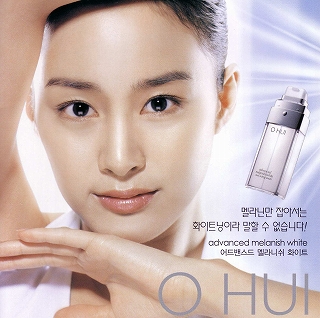
I like this actress Kim Tae Hee.


http://image.blog.livedoor.jp/koreanstyle/imgs/e/8/e8da79a0.jpg


Korea has for a long time being described as the "Eldorado" for imported cosmetic products. It is true that korean people are fond of famous occidental marks. However, they become more and more difficult to satisfy : a simple "Made in France" is not enough anymore to sell in Korea.


Now you have to take local style and liking in consideration, exploit different kind of advertisement to promote your cosmetics and offer better quality products.
Especially when local manufacturers resist to occidental suppliers even in luxurious brand.


The local production represents 2/3 of the actual market and it is not rare observing in Corner Shops of big supermarket, korean products themselves.


Korean Legislation can seem restrictive concerning the input of imported products on the korean Market. Solar products, whitening products and Anti age products have stricter conditions and legislation being considered as more "penetrating" in the skin (filters, anti age actives).

source : http://www.missioneco.org/Coree/documents_new.asp?V=7_PDF_123302 and translated by me


A wonderful actress and model too : Song Hye Kyo.

http://rpm_737.blogs.friendster.com/photos/song_hyekyo/cover-image-song%20hye%20kyo%20cover%20image.jpg


2.22.2007

The cosmetic market in the World


Occidental Europe, with its important population of 388 millions resident is the biggest market in the world with 31,5 billion euros , in 2000.


Switzerland is in first position at both european and world-wide scales, concerning consommation of cosmetics per resident, followed by Japan, United States and France.


Source : http://www.fnege.net/pdf/04partie3/Z-2004.pdf and translated by me


While in Europe, women use 5 to 6 cosmetic products per day, Asia is the sector where the consomation is the largest : Japanese women use between 16 to 18 creams and toners per day and the best consumer is the Korean woman with at least 20 dayly product application !

taken from http://images4.dantri.com.vn/Uploaded/vannt/jeon300906.jpg

For this reason, many european industries export cosmetics in Asia and implant local industries in key towns like Tokyo, Shangai and Seoul.

France is the 3rd supplier of cosmetics in Asia with 13% market share in China.


With a beauty criteria claiming for a white skin in Asia, this continent is the first market in the whole world for suncare products used for protecting skin against UVs.

Of course Asia has its own local cosmetic manufacturer and even tend to concurrence the biggest companies of the world, trying to expend themselves in Asian key countries.


Because I have a big and special interest for Korea, and also because many people don't know much about this interesting and dynamic coutry, I will introduce the korean market in more details in the following chapter.


taken from http://images.google.fr/images Song-hye-Kyo